
For two days, more than 30 individuals from the George Mason University community came together to identify and find creative solutions for cyber dilemmas in higher education. The brainstorming, hacking and presenting yielded tangible proposals.
This creative group gathered as part of Startup Mason’s “Hack Mason 1.0,” an event designed to attract skillful computer programmers, designers and “hustlers” – problem solvers and idea generators – embedded in the Mason community. The hack-a-thon event, open to students, staff, faculty, and the general public, took place on April 5-6, 2013, and was funded by Mason’s Auxiliary Enterprises Department. Attendees came from all over Mason, including the College of Humanities and Social Sciences, the School of Management, the School of Physics, Astronomy, and Computational Sciences, and the Volgenau School of Engineering. Startup Mason is a program of Mason’s Center for Social Entrepreneurship (MCSE).
David J. Miller, the center’s director of entrepreneurship and a PhD candidate in the School of Public Policy, was pleased with the turnout of the event – both in attendance and creativity.
 “We weren’t sure what to expect, but the level of output was unexpected: different and great,” said Miller. “Now, we’re following up with some of the teams to see who will pursue the ideas they presented.”
During a standard hack-a-thon, a group of individuals comes together to fix an Internet-related problem or create an enhancement in a limited amount of time. Hack Mason 1.0 focused on issues of higher education at Mason, such as course catalog data, student life and events, and MOOCs (Massive Open Online Courses). The idea was brought to the MCSE staff by a few engineering students (the MCSE office is physically located in the Engineering Building).
“Companies have been doing hack-a-thons for a long time, whenever they need to solve a problem or give their employees a chance to be really creative,” Miller said. “Being a student suggestion, this fit with the mission for us, and made lots of sense. Historically, a lot of the change in higher education comes from the bottom up.”
Miller’s foresight proved accurate. Hack Mason 1.0 produced four finalist proposals:
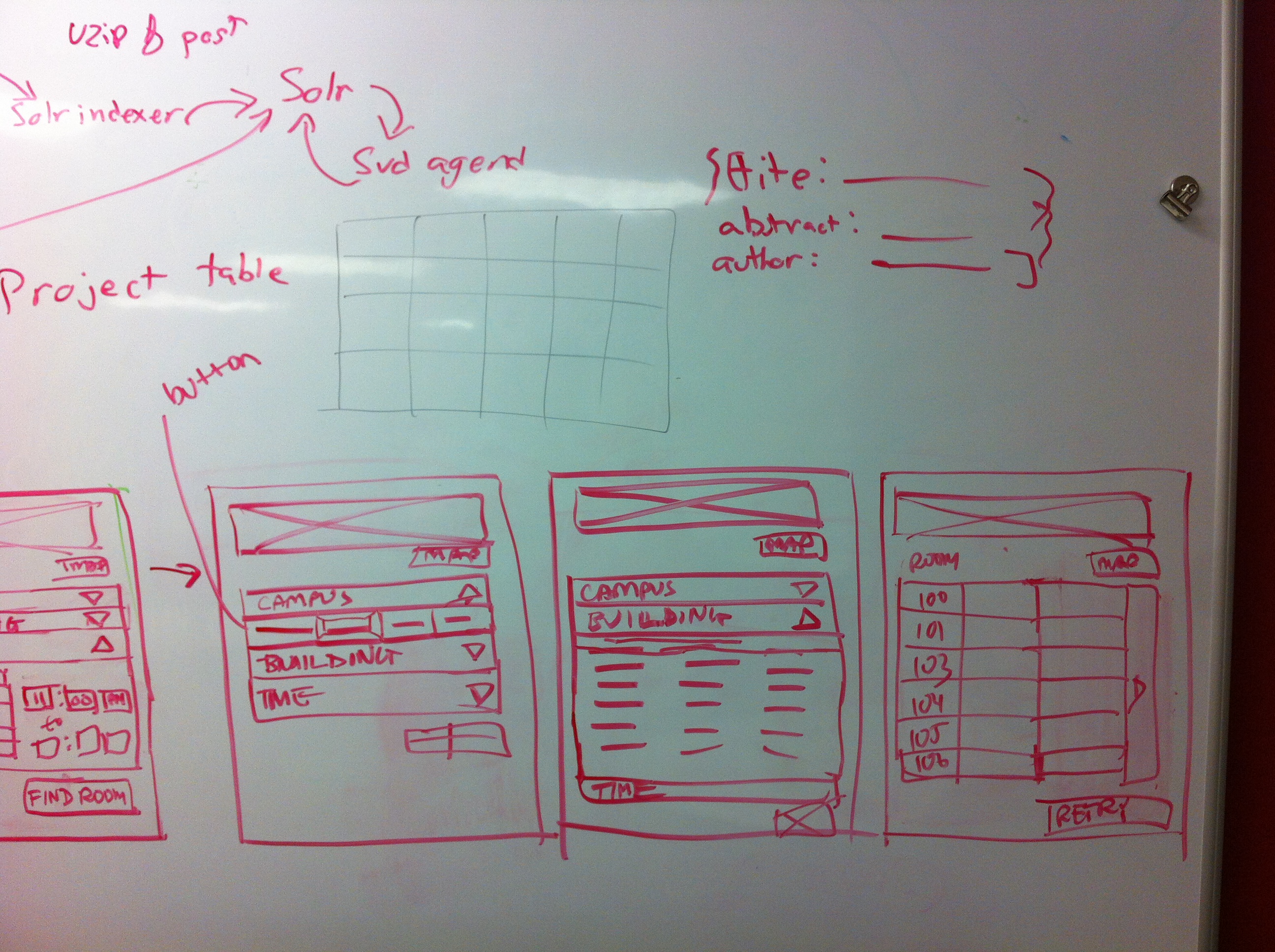
- [Roomy] – An application that provides data on the availability of classrooms and meeting rooms, aggregating data from course catalogs, event calendars, and other sources.
- [Mason Badges] – Mason community members would earn digital “badges” to signify learned skills and knowledge. The provost’s office would feasibly issue these badges once an individual completes a workshop or attends a lecture, having gained a tangible “skill.” Mason Badges will integrate with the Mozilla Foundation’s Open Badges system.
- [Searcher] – A hub for people to store research that wasn’t selected for publication.
- [Mason Nation] – Real time location mapping on campus, integrated with GPS, mapping, and Twitter capabilities.
Miller said he received positive feedback from both participants and four professionals from the software and mobile programming community, who served as judges. Miller plans to host more hack-a-thons in the future. For this group, two days of brainpower opened up all sorts of possibilities.